Race day restrooms in Downtown DC run on a simple ratio: for a 500 runner race, plan on 8 to 10 standard units plus at least 1 ADA unit at the start/finish and every aid station beyond mile 3. Downtown DC Porta Pros builds the layout around your course map, not a guess.
Start with headcount, not distance. A field of 500 runners plus spectators needs more capacity at the start line than out on the course, where units thin out along the route. Downtown DC Porta Pros sizes each water stop and aid station separately from the finish festival, because finish areas hold crowds long after runners cross. Standard porta potty rental units run $130 to $500 for the week depending on count and service frequency, which covers most single-day races when you add a service visit the morning of the event. For a race with real spectator turnout, an event restroom rental package with a higher unit count at the finish line keeps lines short when everyone arrives at once.
ADA coverage is not optional. ADA Standards section 213.2 requires that when single-user units are clustered, at least 5 percent be accessible, and never fewer than one. That means every water stop with more than a couple of standard units needs an ADA accessible porta potty on site too, with a 60 inch turning circle inside per ADA Standards section 304.3.1. We also check door clearance against ADA Standards section 404.2.3, which sets a 32 inch minimum opening, so wheelchair users are not fighting the unit itself. If you are unsure how many units your course legally needs versus how many it actually needs on a hot day, our how many porta potties do I need guide walks through both numbers side by side.
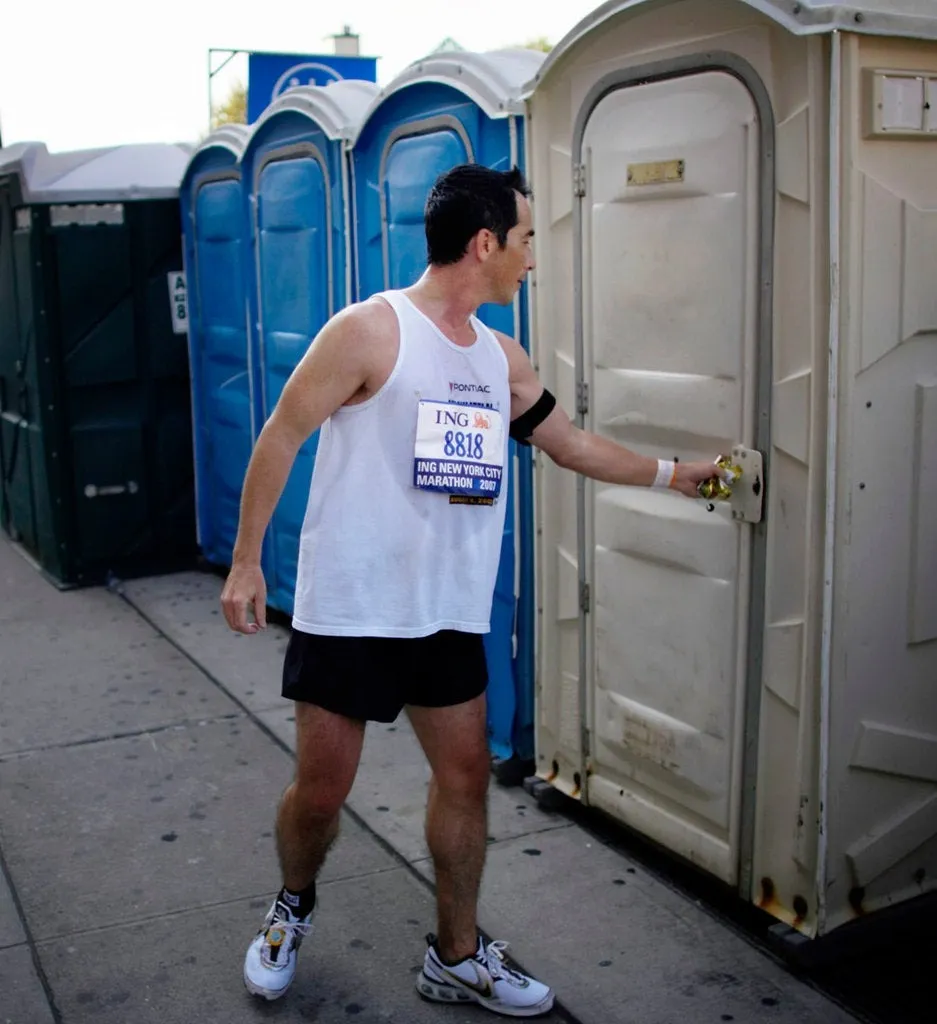
Put them where runners stop, not where it is easiest to park a truck. Start/finish festivals, aid stations past mile 3, and any medical tent cluster all need their own restroom count, sized independently. A porta potty placement guide helps race directors walk the route in advance and mark firm, level ground, since ADA Standards section 302.1 requires stable, slip resistant surfaces at every accessible unit. Downtown DC delivery crews need roughly 60 feet of straight clearance behind the truck for larger drops, which matters most at finish festivals where a restroom trailer rental or 4 stall restroom trailer is staged for VIP or medical use.
Race organizers running finish line lighting or timing equipment off generators should also plan power placement early. If you're asking how to brace a temporary power pole for a finish line arch or a lit aid station, treat it the same way you treat restroom footing: firm ground, clear of the runner lane, and staked against wind gusts before dawn setup. Pair that with a temporary power pole placed away from foot traffic, and keep light tower rental units on the same stable pad standard. For hydration stops, a handwashing station rental next to the water table keeps volunteers compliant with 29 CFR 1910.141(d)(2), which requires soap and towels or a hand drying device, not sanitizer alone. Course marshals directing runners around restroom clusters should follow barricade guidance consistent with OSHA 1926.202, keeping barriers out of the running lane itself.
Placement in the public right of way needs confirming with the city before you finalize your course map. Downtown DC has specific rules for street closures and sidewalk obstructions during races, and those requirements were not verified for this page, so check directly with the city permitting office before locking in unit locations. Our porta potty permit requirements page outlines the kind of questions to ask, even where the specific Downtown DC answer still needs confirming.
Budget matters too. A porta potty rental cost breakdown or the porta potty rental per day rate helps you compare a single-day race against a multi-day stage event. Races near Hyattsville, 6.4 miles northeast, or Takoma Park, 6.5 miles north, often share the same delivery window, so ask about combined routing if your event sits near either boundary. Downtown DC Porta Pros also services Bladensburg, 6.5 miles northeast, and College Park, 10.2 miles northeast, for regional relay events that cross municipal lines.
Book as soon as your course map is final, ideally 4 to 6 weeks out for a race over 500 runners. Peak race season books fast in Downtown DC, and ADA units in particular run limited stock. Waiting until race week usually means fewer accessible unit choices.
Most races use standard units at aid stations and a mix of standard and deluxe flushable porta potty units at the finish festival. A standard unit measures about 44 by 48 inches on the ground and stands 92 inches tall, which fits most sidewalk and grass placements without blocking the running lane.
Yes, alongside any restroom cluster. Volunteers handling food or drinks at aid stations should have handwashing access under 29 CFR 1910.141(d)(2), which specifically requires soap and towels or a hand dryer. A portable sink rental unit works well next to water tables.
Early morning delivery is common for races starting before city traffic builds. Confirm your delivery window when you book, since Downtown DC street closures for the race itself can affect truck access timing near the start line.
A same-day service call handles it. For longer races or multi-day events, ask about an emergency porta potty rental add-on so a service truck can reach any aid station fast if a unit fills faster than expected.
Yes. Downtown DC Porta Pros delivers marathon and race restrooms across Downtown DC and the surrounding metro, with same-day and next-day drop-off available on most orders.
Pricing depends on the unit and how long you need it. See our cost breakdown and request a free quote for an exact figure.
Standard rentals include scheduled service — a pump-out, a clean, a restock and fresh deodorizer. Busy or hot-weather sites can be serviced more often.
Call now or request a free quote — clean units, on-time delivery, transparent pricing.